

Bill C-46, which overhauled Canada’s impaired driving laws, received royal assent on June 21, 2018. The new drug-impaired driving offences took effect that day, and the rest of the reforms, including a rewritten scheme for alcohol-impaired driving in Part VIII.1 of the Criminal Code, came into force on December 18, 2018.
The changes were tied to the legalization of cannabis, but Parliament went much further than drug-impaired driving. It gave police new screening powers, narrowed long-standing defences, and raised maximum penalties. That last change has had an outsized effect on permanent residents, students, workers, and visitors who are not Canadian citizens.
Mandatory alcohol screening
Before December 2018, police needed a reasonable suspicion that a driver had alcohol in their body before demanding a roadside breath sample. Section 320.27(2) of the Criminal Code removed that requirement. An officer who has an approved screening device on hand and who has lawfully stopped a driver can now demand a breath sample with no suspicion at all.
The provision has been repeatedly challenged under the Charter. In R. v. Wright, 2025 SKCA 52, a majority of the Saskatchewan Court of Appeal found that mandatory screening does infringe the Charter but upheld it as a reasonable limit under section 1, over a strong dissent. The Supreme Court of Canada declined to hear the appeal in January 2026. In R. v. Jerlo, 2025 ONCJ 586, Ontario Court of Justice in R. v. Jerlo recognized broad consensus at the trial level that mandatory alcohol screening demand is constitutional, citing the Saskatchewan Court of Appeal’s decision. The Charter permits police to employ this investigatory step without any grounds whatsoever, as police must simply comply with statutory requirements before demanding a driver provide an alcohol screening sample.
That does not end the inquiry in an individual case. The stop itself must still be lawful, the officer must actually have an approved screening device, and the sample must be demanded and taken immediately. Refusing a lawful demand is a separate criminal offence that carries a minimum $2,000 fine for a first offence.
Narrower defences for the accused
The 2018 reforms also made “over 80” charges harder to defend. The offence now covers having a blood alcohol concentration of 80 mg or more within two hours after driving, not only at the moment of driving. Results from an approved breath instrument are presumed accurate, and the traditional “last drink” and “intervening drink” defences survive only in narrow circumstances.
These cases are still defensible. The Charter, the lawfulness of the stop and the demands, the timing of the tests, and the disclosure about the instrument all remain live issues. But the room for error by an accused person, and by their lawyer, is smaller than it used to be.
Impaired driving and immigration status
Bill C-46 raised the maximum penalty for impaired driving, “over 80”, and refusal from 5 to 10 years’ imprisonment when the Crown proceeds by indictment. On summary conviction the maximum is two years less a day. Most first offenders receive a fine and a driving prohibition, and the higher maximum rarely changes the sentence a judge actually imposes.
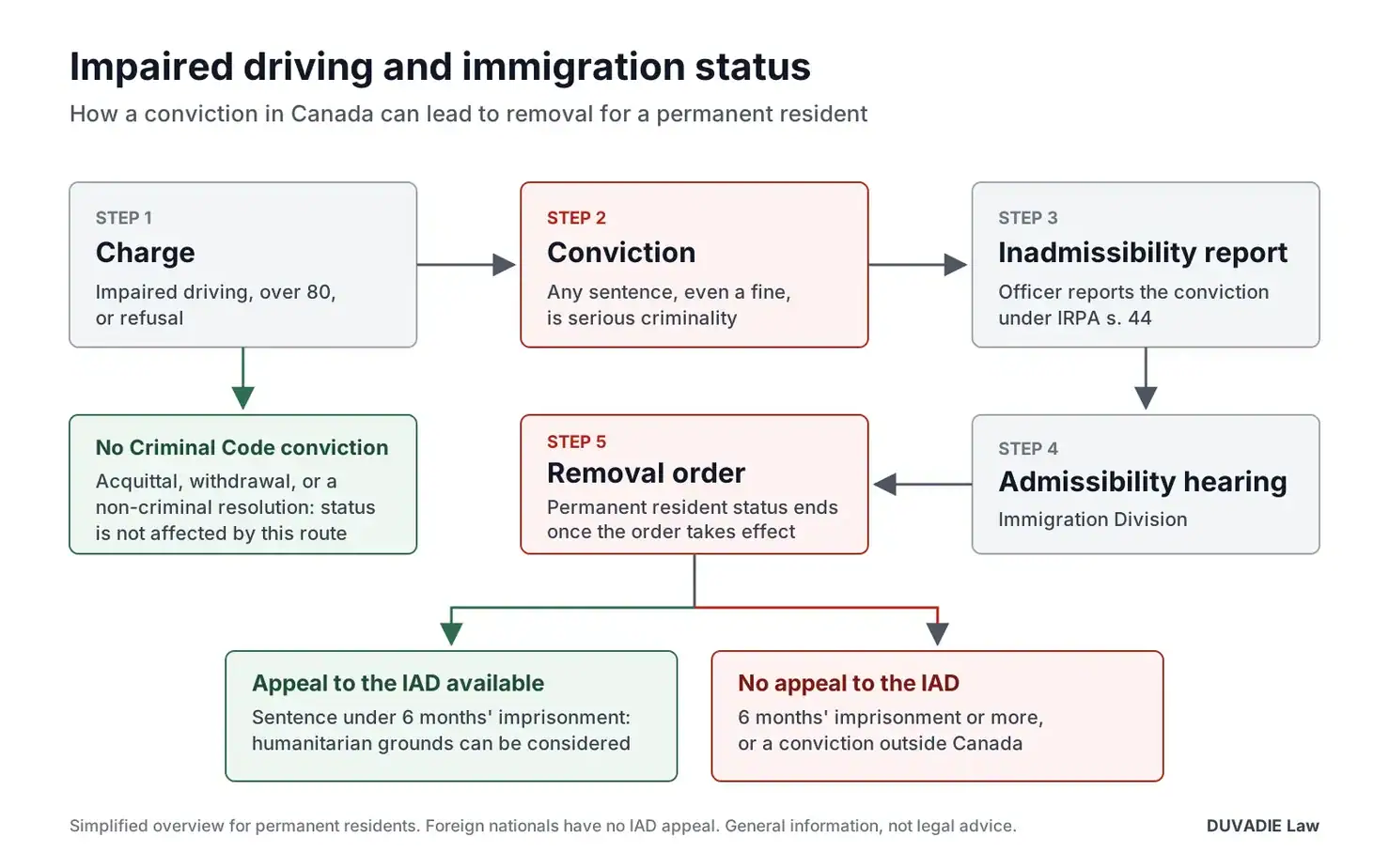
It does change the immigration consequences. Under section 36(1)(a) of the Immigration and Refugee Protection Act (IRPA), a permanent resident or foreign national convicted in Canada of an offence punishable by a maximum of at least 10 years is inadmissible for “serious criminality”. Section 36(3)(a) treats hybrid offences as indictable for this purpose, even when the Crown proceeds summarily. As a result, a first conviction for impaired driving or “over 80” with no accident and no injury now amounts to serious criminality.
What matters is the maximum penalty, not the sentence. A $1,000 fine on a first-offence impaired driving conviction can still lead to an inadmissibility finding.
Permanent residents
A conviction can lead to an inadmissibility report, an admissibility hearing, and a removal order. Permanent resident status is lost once that removal order takes effect. A permanent resident can usually appeal the removal order to the Immigration Appeal Division on humanitarian grounds, but that right is lost if the sentence includes six months or more of imprisonment, and it is not available for convictions entered outside Canada.
Students, workers, and visitors
Foreign nationals with temporary status become inadmissible, may lose their permits, and have no appeal to the Immigration Appeal Division. A conviction can also derail a later application for permanent residence.
Convictions outside Canada
An impaired driving conviction from another country, for an offence committed on or after December 18, 2018, is generally treated as serious criminality under section 36(1)(b). Deemed rehabilitation is not available for serious criminality. A person in that position must apply for criminal rehabilitation once five years have passed since the sentence was completed, or seek a temporary resident permit in the meantime.
Offences before December 18, 2018
The Supreme Court of Canada held in Tran v. Canada, 2017 SCC 50, that the maximum penalty is assessed as of the date of the offence. Impaired driving committed before the reforms took effect is, therefore, generally not serious criminality.
What non-citizens should do if charged
For a Canadian citizen, a guilty plea to a first-impaired driving charge is often a pragmatic way to end the case. For a non-citizen, the same plea can put their status in Canada at risk. The decision about how to resolve the charge has to be made with the immigration consequences in view from the start.
Depending on the evidence, the options may include a trial, a negotiated resolution to a provincial offence such as careless driving under the Highway Traffic Act, which is not a criminal conviction, or another outcome that avoids a Criminal Code conviction altogether. None of these is guaranteed, and each depends on the strength of the Crown’s case and the willingness of the Crown to resolve it.
The same offence carries very different consequences, depending on citizenship. A citizen convicted of a first-impaired driving offence pays a fine and loses their licence for a year; a permanent resident convicted of the same offence can face removal from the country. Anyone without Canadian citizenship who is charged should get advice on both the criminal and the immigration side before entering any plea.
This page provides general information, not legal advice. The law and its application change, and every case turns on its own facts.
Page last updated